
Florida Commercial Eviction Laws Every Landlord Should Understand
Commercial tenancies in Florida are governed by Florida Statutes Chapter 83, Part I.
That section controls non-residential leasing relationships involving office buildings, retail space, industrial properties, warehouses, restaurants, and other commercial premises. The part of Chapter 83 has far fewer regulations than the residential part. This is based on the premises that commercial tenants are on equal footing with their landlords and more able to defend themselves.
Most commercial leases contain lengthy provisions dealing with default, termination, maintenance obligations, insurance requirements, operational restrictions, assignment rights, and remedies after breach.
A landlord cannot simply decide the lease is over and physically remove the tenant from the property. Florida courts still require formal eviction proceedings before possession changes hands.
BrowardLandlord.com handles commercial eviction matters in any county in Florida.
Florida Does Not Allow Self-Help Commercial Evictions
This is the mistake that causes some of the biggest problems.
Commercial landlords are required to pursue possession through the court system. Even when the tenant clearly breached the lease agreement, the landlord cannot bypass formal eviction procedures.
BrowardLandlord.com warns landlords directly about self-help tactics because the consequences can become expensive quickly. While the commercial part of the statute does not provide the penalty of 3 months rent as the residential part does, it still entitles the tenant to actual damages, fees and costs.
Most Commercial Evictions Begin with Lease Default
Nonpayment of rent remains the most common trigger for commercial eviction cases, but it is hardly the only one.
Florida commercial landlords also pursue eviction after:
Unauthorized subleasing
Illegal business activity
Property damage
Failure to maintain insurance
Violations involving use restrictions
Unauthorized occupants
Expiration of the lease term
Refusal to vacate after termination
Commercial leases often contain detailed default provisions that control what happens next. Other breaches may need to be remedied and/or acknowledged before the eviction action. Others permit immediate termination depending on the lease language.
That is why reviewing the lease carefully matters before serving notices or filing suit.
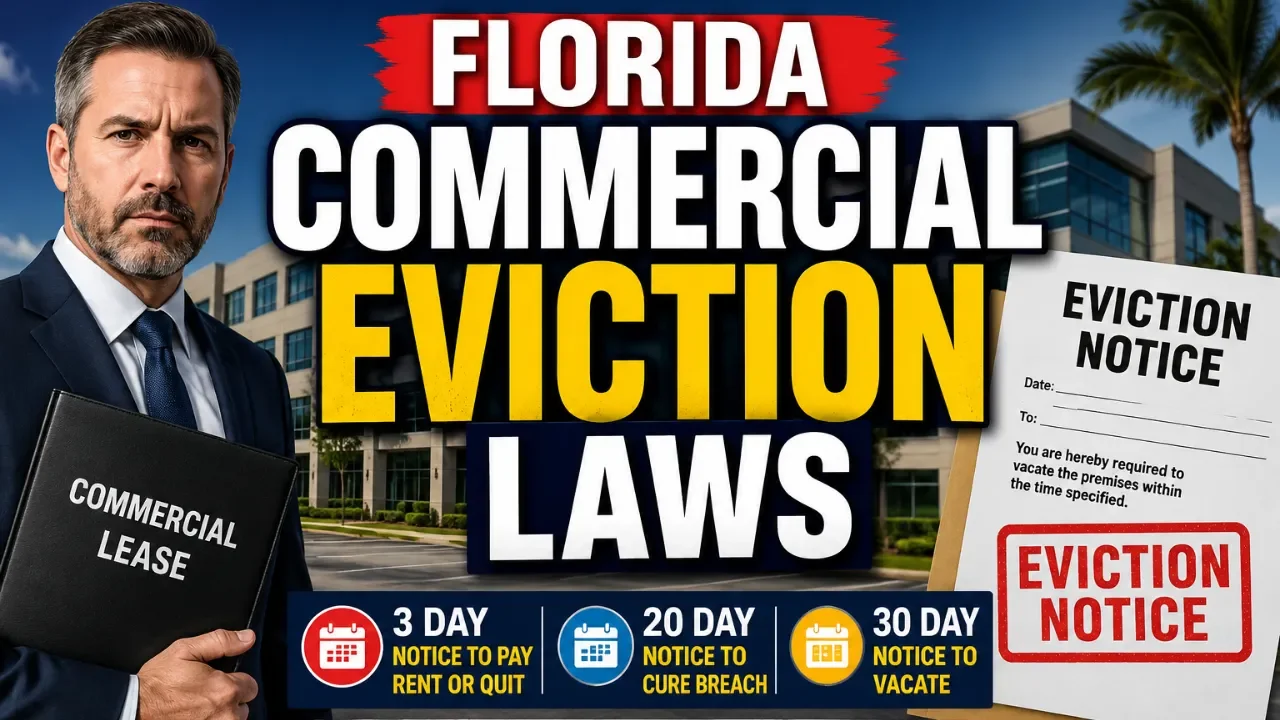
Non-payment of rent requires service of a 3 Day Notice to pay rent or quit.
Lease violations require a 20 Day Notice to Cure the breach.
Termination of a month to month commercial tenancy requires 30 days notice before the roll over date.
Commercial eviction cases are about the same cost and take about the same amount of time if they are heard in County Court, which has a jurisdictional limit of $50,000.00. For cases involving more than this amount the case will be in Circuit Court and will be considerable slower and more expensive. As commercial leases are often for a period of many years and contain a rent acceleration clause in the event of a default, it not unusual to reach this amount of damages.
Conclusion
Florida commercial eviction law is procedural from start to finish. Landlords cannot legally recover possession through lockouts, utility shutoffs, or other self-help tactics, even when the tenant clearly violated the lease. Florida Statutes Chapter 83 Part I mandates that landlords properly terminate the lease and begin the court action to have the tenants removed.
BrowardLandlord.com and Alexander Patrick Johnson PLLC have many decades of experience in assisting commercial landlords in Florida. When conflicts get to a point of escalation, a knowledge of notice requirements, lease terms, and court procedures, positions the property owner in a much stronger position.